Jiu-jitsu belts: how long each one takes, and why people quit at blue
How long it really takes to reach blue belt, what we look for before awarding a stripe, how the kids' belt system works, and why so many adults stop after their first promotion.
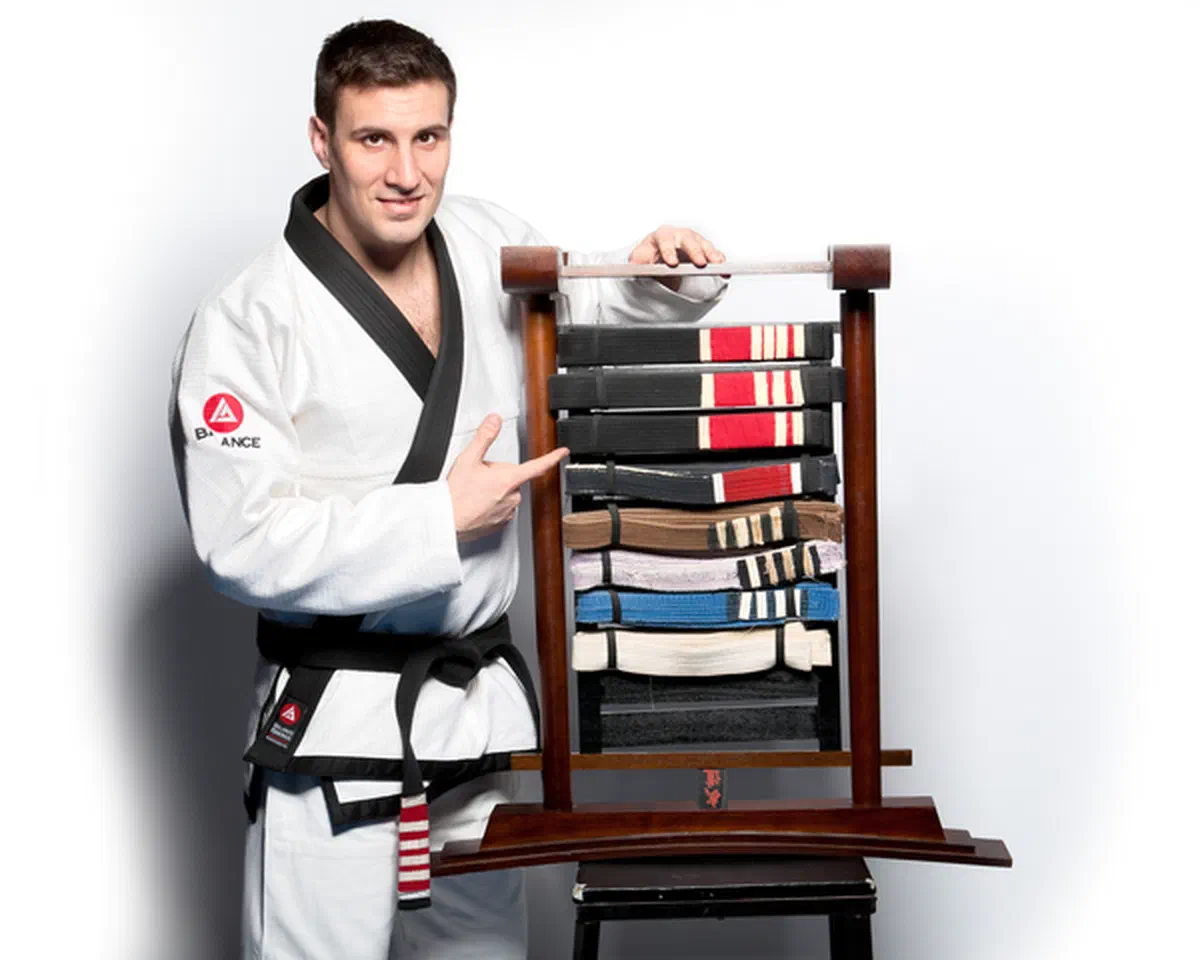

“How long until blue belt?” Some people ask before their first class is over. The honest answer from our side of the mat: it took us about two years, training three or four times a week. Nothing dramatic happened at the end of those two years. A few basic techniques simply started to work, mostly against people who had trained for less time than we had. That’s what a blue belt usually means.
The belts
The adult system has five main belts: white, blue, purple, brown and black. White through brown belts can receive up to four stripes; black belt uses a separate degree system.
Typical time to the next belt:
The minimum ages shown here follow the current IBJJF graduation system. The timelines are our realistic estimates for someone who trains three times a week. Plenty of people take longer, and that’s fine.
Children aged 4 to 15 use a separate set of belt colours:
| Belt colour group | Age |
|---|---|
| White | 4+ |
| Grey | 4–15 |
| Yellow | 7–15 |
| Orange | 10–15 |
| Green | 13–15 |
At 16, a teenager moves into the adult belt system, and their coach may promote them directly to blue.
What we look for before awarding a stripe
This part is a little controversial, so here’s how we see it.
There are roughly two kinds of schools. In the strict ones, you earn every stripe on the mat: the coach watches you roll and decides. In others, promotion follows attendance and a set curriculum, so a certain number of sessions and technique classes leads to the next stripe. We’ve trained in both, and we don’t think either is wrong. People who prefer the strict approach complain that other schools “just give belts to anyone who pays.” Our answer is: so what?
When we started coaching, we promoted people purely by watching them. Over time we saw that this didn’t work for everyone. We still watch closely, but we also track how often, and over how long a period, each person has trained.
Take two blue belts. One is 17 and competes every month. The other is a father of three who comes to class on an evening he could have spent with his children. Add a stripe to the teenager’s belt and everyone on the mat can still see the difference between them. So should the father have to wait longer? He keeps turning up. He keeps trying. His coordination may never match the teenager’s. Who is actually giving more?
You can’t measure someone’s effort only by what their body can or can’t do. This isn’t an Olympic team.
Kids’ belts and parents
Some parents don’t think about belts at all. Others take them very personally: “Why didn’t my child get a stripe when that child did?” We tried promoting the more advanced children faster, and it didn’t work. From the side of the mat, a parent can’t always see the difference between their child and the next one, and it isn’t fair to expect them to.
So we use the same rule for every child: a set number of classes within a set period earns the next stripe. Parents can follow their child’s progress online, and nobody has to wonder why one child moved up and another didn’t.
The mistakes that slow beginners down
The most common mistake isn’t laziness. It’s the opposite. New people get excited, come to every class and try to learn everything at once. Then they get lost in how much they don’t understand yet. Jiu-jitsu is a marathon, not a sprint. You have to be ready to keep turning up for a long time.
The second mistake is relying on strength. It’s natural: nobody likes being submitted, and most of us are competitive. But tapping is one of the ways this sport teaches you. Every position that makes you tap tells you something about where things went wrong. If you never let yourself get caught in training, you never get the chance to find out.
Beginners often ask us, “What did I do wrong there?” Usually the answer is: everything. That’s how it’s supposed to be. If you already knew how to do it right, you wouldn’t need a coach.
Why people quit at blue belt
We’ll be honest: we don’t fully understand it. But we have a good guess.
The people who stop at blue are mostly adults, not teenagers. Think of the belt system like school grades. A child who reaches third grade doesn’t say “I know enough now” and leave school; adults make that decision for them. Adults can decide to stop. Many expect two years of training to put them at a particular level. Jiu-jitsu doesn’t work like that. There’s always someone better, and blue belt is a small step near the beginning of a long road.
Burnout is real. People train hard without enough rest, on top of work and family, and wonder why it still feels difficult. It never gets easier. You just get better.
Some quit because a new belt brings pressure. Partners may roll a little harder with a blue belt, though that happens at every rank. It can feel easier to stop and keep the belt than to carry on and let people see you’re not yet as good as you think the belt says you should be.
Injuries are often given as a reason too. You can’t prevent every injury, but many come from training too hard, tapping too late, or an unhealthy gym culture. If you’ve piled up several serious injuries by blue belt, it’s worth looking honestly at how, and with whom, you train.
If you remember one thing from this page, remember this: jiu-jitsu is a process. Don’t rush it.
The timelines in this article reflect our coaching experience and are not guaranteed schedules. Check minimum ages and formal requirements against the current IBJJF graduation system. Different academies may use different promotion standards.